

FTP Server
This is a little history behind the current FTP server that you connect to when you go to ftp.hostingmojo.com. The FTP server is rather simple. Let's have a look at the system specs:
|
Black rackmount 4U case with 300W power supply |
|
MSI K7T Turbo2 motherboard |
|
TNT video |
|
Duron 900 CPU |
|
384MB PC133 SDRAM |
|
Adaptec ATARAID 1200A IDE RAID controller |
|
2-IBM 20GB hard drives in RAID1 (system) |
|
2-Western Digital 120GB hard drives in RAID 1 (FTP/file drive) |
|
Tekram DC-315U SCSI card |
|
Sanyo SCSI 4X CD-R |
|
Exabyte 4GB tape drive |
|
|
| Floppy drive | |
|
|
| Linksys NIC v4.1 | |
|
|
| Linksys Gigabit Ethernet card | |
|
|
| Windows 2000 Server SP3 | |
|
|
| Rhino Soft's Serv-U v4.0 | |
|
ArGoSoft email server v1.8 |
|
Before the new FTP server was built, web server v2 handled all the FTP communication for the site. At that time the only FTP traffic was people accessing their personal folders on the web drive. All my music, movies, and software was stored on my own personal computer. That worked fine while I was home, but one of the things I really liked about the first FTP was the ability to access all my software at home even while I was out on the road. If I forgot something, all I needed was an Internet connection and I could download it. I wanted that back. I also decided to enable the guest FTP access again for everyone else to use.
For safety, I wanted a few back-up features on the new FTP/file server. The Windows 2000 software RAID was out of the question since I'd had better luck with a simple NTFS volume on an old IDE drive. Hardware RAID is the way to go if you need RAID. To keep the cost down, I chose the Adaptec RAID controller and two pairs of IDE drives rather than a SCSI RAID setup.
In addition to using hardware RAID1 (mirroring), I wanted a way to back up large amounts of data in case my large drive failed. I didn't want to repeat the first web server crash and lose tons of data. I heard about a tape drive for sale at a reasonable price and decided to buy it. Although tapes are a little slower than a CD-R, they hold more information. Each tape for the Exabyte I have holds 5GB. To back-up approximately 65GB of data would require a little less than 100CD-R's, yet only 13 tapes.
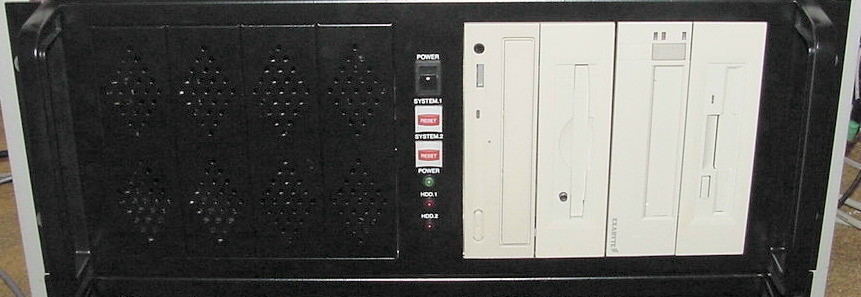
Since I didn't want to attack my brand-new tape drive with a spray can, I just left all four drives beige.
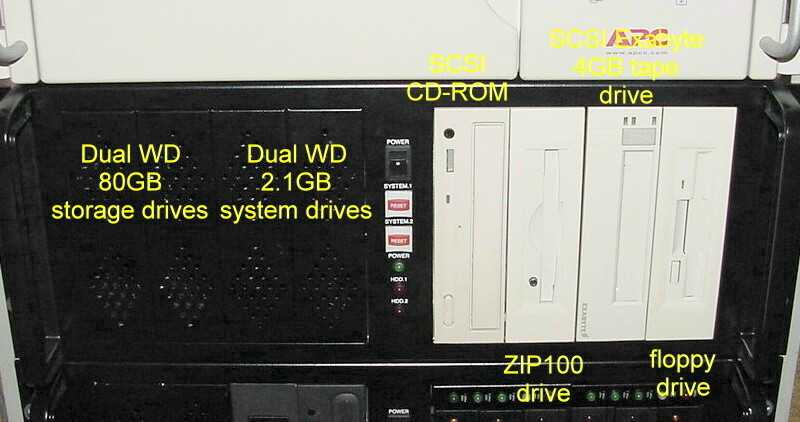
Other than the Adaptec RAID card, rackmount case, and tape drive, the FTP server was constructed out of spare parts. Since the FTP server is also a file server for my LAN, I installed a ZIP drive in case I needed to upload or download files to a ZIP for transport. Update: The FTP server was originally equipped with two WD 2.6GB hard drives that have been replaced by two faster IBM 20GB hard drives.
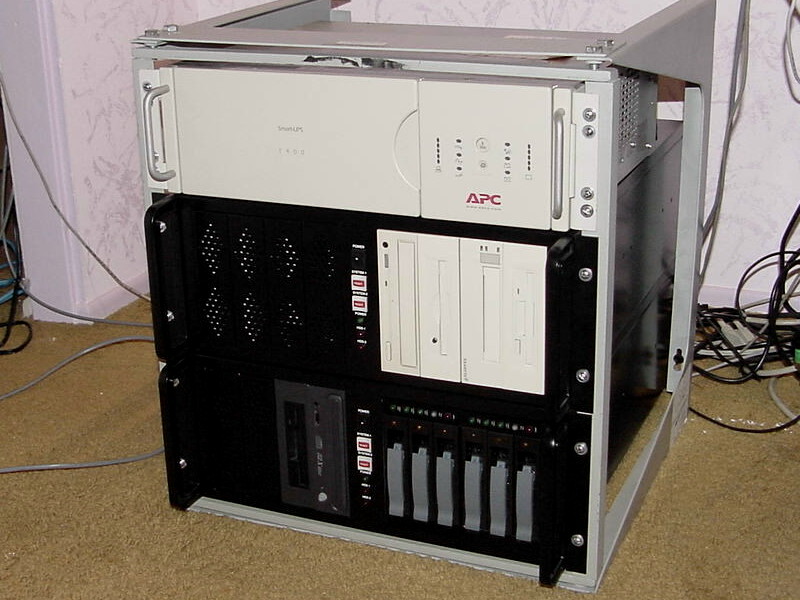
The information on the storage drives doesn't change often, so the tape drive is primarily used to do a nightly back-up of the data on the web server. This picture shows APC 1400 (top), FTP server (middle), and the new web server (bottom).
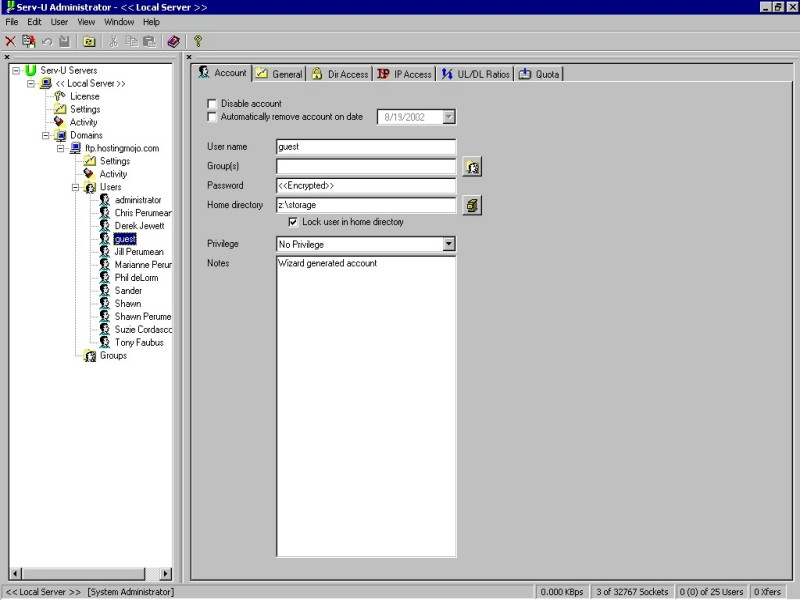
The FTP server software is a nice setup from Rhino Soft, the makers of FTP Voyager. When users connect to the FTP they can access the large local storage drive or the remote web drive on the web server.
So now when you type in ftp.hostingmojo.com, you have an idea about what's at the other end of the line. I suggest reading the Web Server v3.0 article to finish the story.

This FTP server runs these sites and services: